Up & Down Outdoor Wall Lights (2026): How to Wash a Facade With Light
Quick answer: An up and down outdoor wall light has two light sources, one aiming up and one aiming down, so it paints two beams of light on the wall above and below the fixture. To wash a facade evenly, mount the lights about 6 to 7 feet (1.8 to 2.1 m) above the ground, space them roughly 6 to 10 feet (1.8 to 3 m) apart, use warm 2700K to 3000K LED bulbs, and choose IP64 or higher for walls that take direct rain, or IP44 to IP54 for covered or sheltered spots.
Up and down lights are one of the simplest ways to make a house look finished at night. Instead of one bright point beside the door, they draw clean vertical lines of light on brick, render, stone or siding, which shows off texture and makes the building read as architecture rather than a dark shape. They also light the ground below, so they are useful as well as decorative. This guide covers how they work, how to space and mount them, which IP rating you need, and which bulbs give the effect you want.
What is an up and down outdoor wall light?
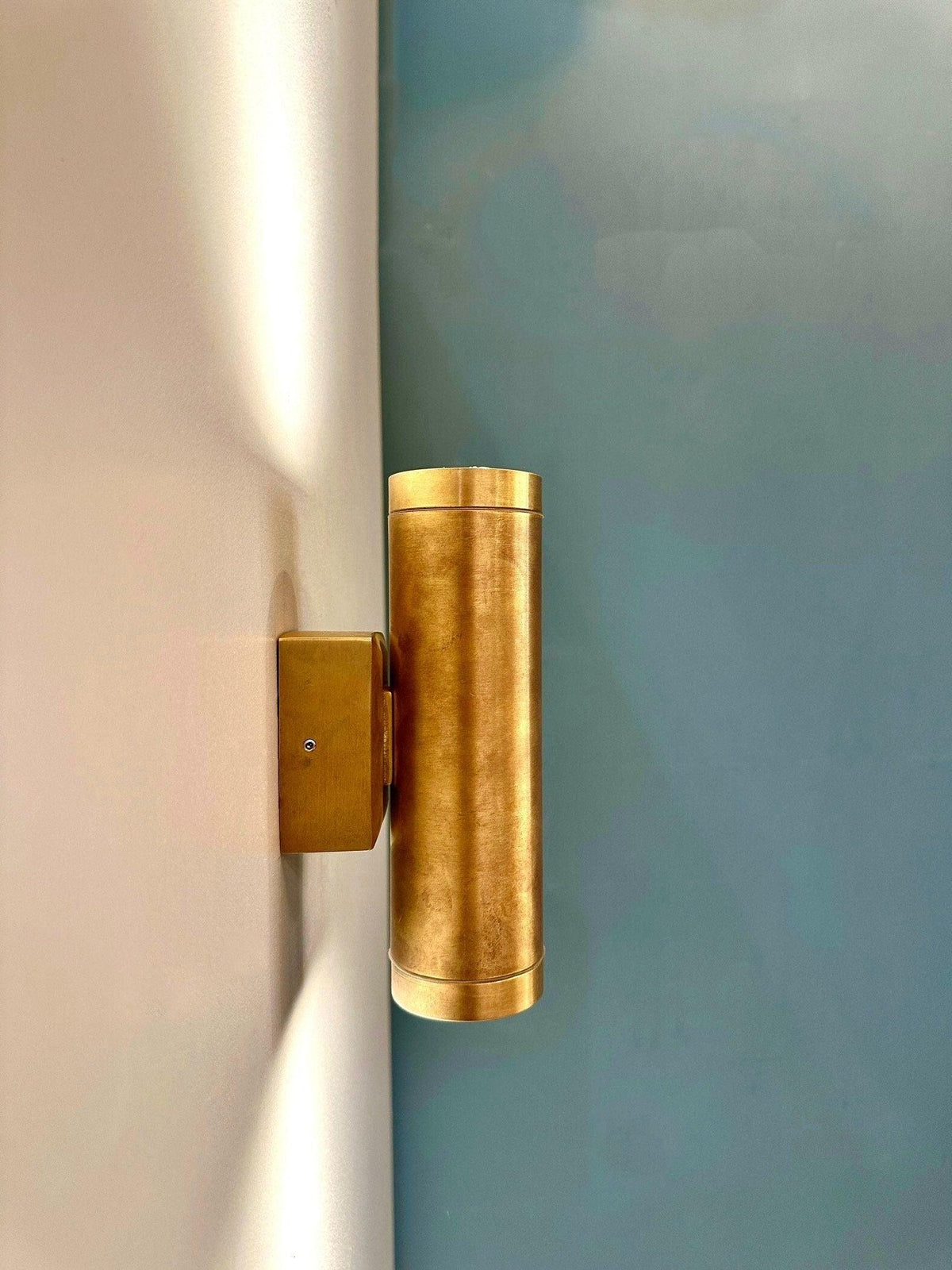
It is a compact wall fixture, usually a cylinder or a slim box, with an opening at the top and the bottom. Each opening holds a lamp, most often a GU10 LED, so the light leaves the fixture in two directions. The result on the wall is a pair of beams, one rising toward the eaves and one falling toward the ground. Because the body sits close to the wall and the bulbs face away from the viewer, you see the light on the surface rather than a bright bulb.
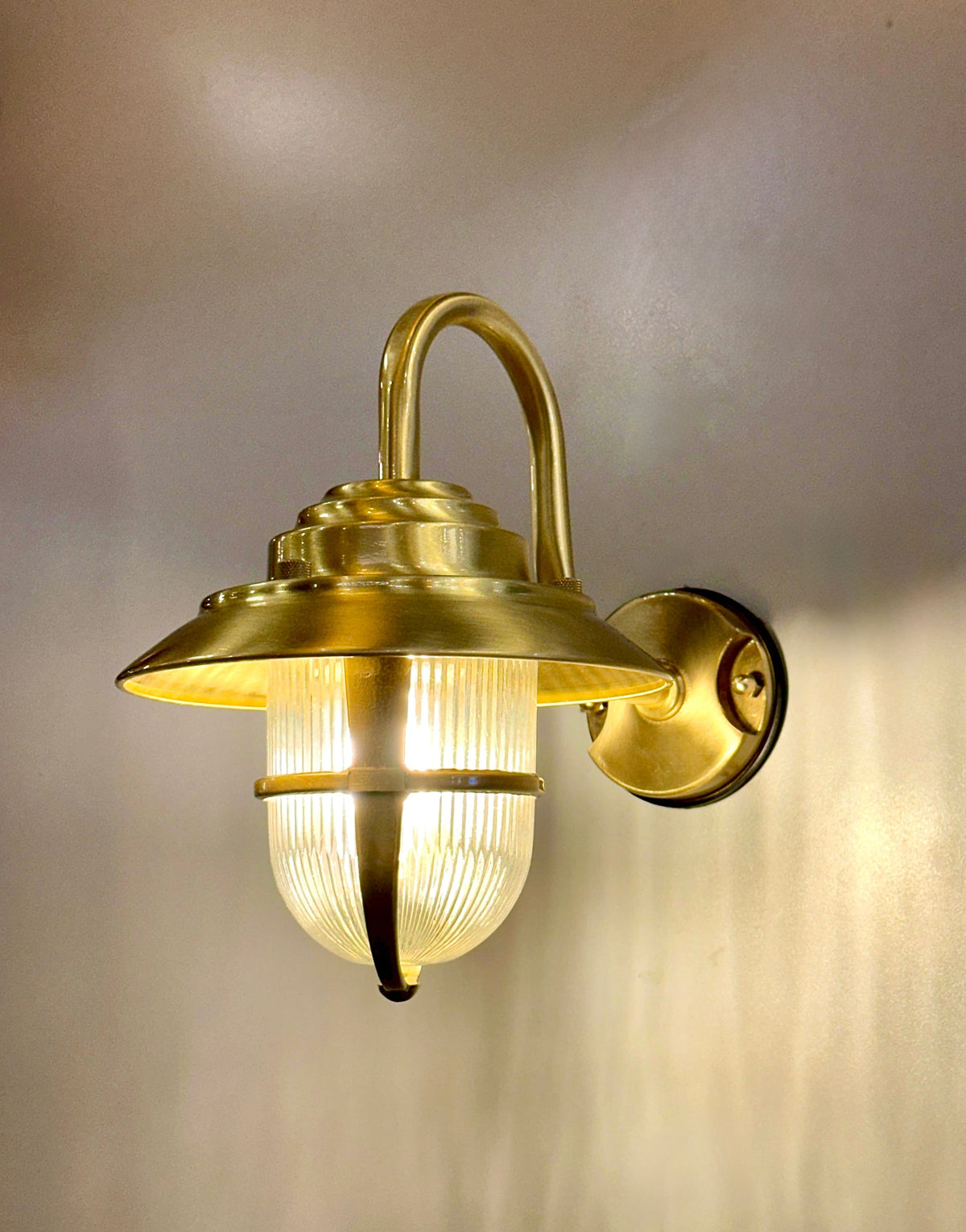
They are different from a gooseneck light, which reaches out and throws light down onto a door or sign, and from a bulkhead light, which glows all around close to the wall.
Where do up and down lights work best?
- Long facades. A row of evenly spaced lights gives a rhythm of vertical beams that makes a plain wall look intentional.
- Either side of a front door or garage. A matching pair frames the opening and lights the step or driveway below.
- Textured walls. Stone, brick, board-and-batten and rough render all look richer when light grazes across them from close range.
- Patios, terraces and garden walls. They give soft, indirect light for seating areas without a bright bulb in anyone's eyes.
- Columns and pilasters. One light centered on a column turns it into a feature after dark.
How does a facade wash actually work?
The light hits the wall at a very shallow angle, so every bump and joint casts a small shadow. That is why brick and stone look so good under up and down lights, and why smooth render shows any unevenness. Three things control what you see:
Beam angle of the bulb. A narrow GU10 beam (around 15 to 25 degrees) draws tight, defined lines that travel further up the wall. A wider beam (around 36 to 60 degrees) gives a softer, broader fan that blends with the next fixture sooner. Because most up and down fixtures use standard GU10 bulbs, you can change the look later just by swapping bulbs.
Distance to the eaves and ground. The further the beam can travel, the longer the line. If the fixture sits just under a soffit, the upward beam stops short and creates a bright patch on the underside of the eave, which some people like and others do not.
Wall color. Light walls reflect more and look brighter with the same bulb. Dark brick or stained wood absorbs light, so you may want slightly brighter bulbs or closer spacing.
How far apart should up and down lights be?
| Situation | Mounting height | Spacing | Bulb beam |
|---|---|---|---|
| Single-story facade | About 6 ft (1.8 m), or halfway up the wall | 6 to 8 ft (1.8 to 2.4 m) | Medium, 25 to 40 degrees |
| Two-story facade | About 7 ft (2.1 m) | 8 to 10 ft (2.4 to 3 m) | Narrow, 15 to 25 degrees, to reach higher |
| Pair beside a door | Top of fixture near the top third of the door | One on each side, 6 to 12 in (15 to 30 cm) from the frame | Medium |
| Garage door | About 7 ft (2.1 m), or just above door height | One each side; add one between double doors | Medium to wide |
| Patio or garden wall | 4 to 6 ft (1.2 to 1.8 m) | 5 to 8 ft (1.5 to 2.4 m) | Wide, 40 to 60 degrees, for a soft glow |
A few practical rules help more than exact numbers:
- Line up with the architecture. Center lights on piers, between windows, or on the gaps between openings. A regular rhythm looks better than lights placed only where the junction boxes happen to be.
- Keep the same height along one wall. Even a small difference in height shows clearly once the beams are lit.
- Avoid windows directly above. An upward beam that hits a bedroom window will shine into the room. Shift the light sideways or use a narrower beam.
- Test before you fix. If you can, hold a light in place at dusk with a temporary connection, or at least shine a flashlight up the wall, to see where the beams land.
For door and porch heights in more detail, see our outdoor wall light height guide.
What IP rating do up and down lights need?
The IP rating tells you how well a fixture is sealed against dust (first digit) and water (second digit). For outdoor up and down lights, the upward opening is the part to think about, because it faces the sky.
| Location | Suggested rating | Why |
|---|---|---|
| Under a deep porch roof or covered patio | IP44 to IP54 | Protected from direct rain, but exposed to damp air and splashes |
| Open facade, garden wall, poolside | IP64 or higher | Dust-tight and protected against water splashing from any direction |
| Coastal home with wind-driven rain and salt spray | IP64 or higher, in solid brass | Sealing plus a body that will not rust |
| Bathroom, outside the shower zone | IP44 or higher | Steam and occasional splashes |
Our IP ratings guide explains each digit, and our IP64+ collection lists the fixtures suited to exposed walls. Material matters as much as sealing near the sea: solid brass darkens into a patina rather than rusting, while plated steel can bubble and flake. More in our coastal durability guide.
Which bulbs should you use?
- LED only. Up and down fixtures are compact and enclosed, so LED GU10 bulbs run cooler and last longer. Always stay under the maximum wattage listed for the fixture.
- Warm color temperature. 2700K to 3000K suits brass, brick, stone and wood. Cooler light can make warm materials look gray. See our color temperature guide.
- Match bulbs along the facade. Use the same brand, wattage, beam angle and color temperature in every fixture on one wall so the beams look identical.
- Dimmable if you want control. Dimmable LED GU10s with a compatible dimmer let you turn a bright facade down to a soft evening glow.
Handmade up and down outdoor wall lights to consider
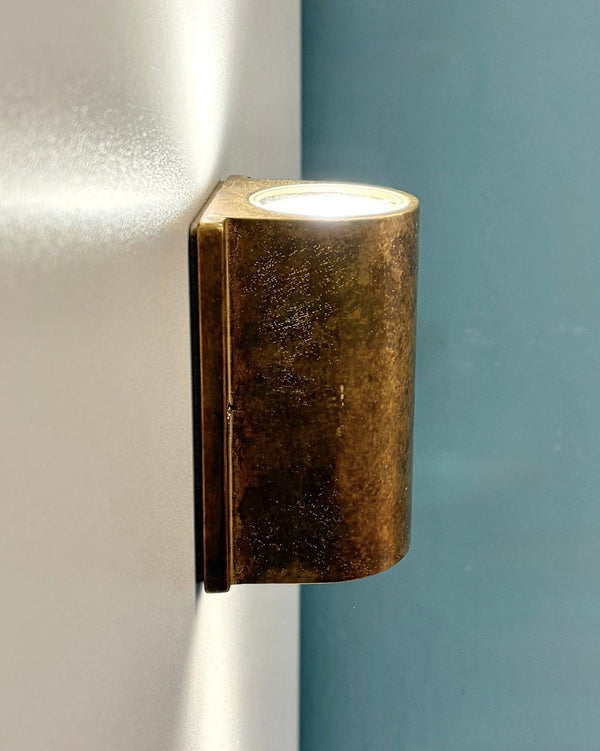
LIDAR: a compact cylinder of cast brass with a naturally mottled finish and a glass diffuser that softens the light. Rated IP64, so it suits exposed facades, patios and paths. It takes two GU10 bulbs and measures about 5.2 inches tall, 3.5 inches wide and 3 inches deep (13.3 x 9 x 7.6 cm), small enough for tight spots between windows.
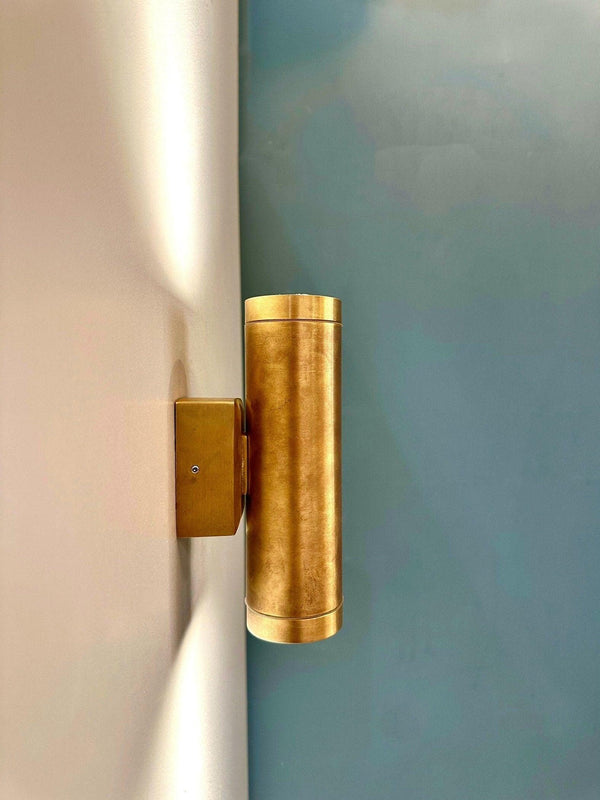
NITRA: a slim, taller up and down light made from brass casting, designed to wash the wall with light above and below. Rated IP64, with two GU10 sockets for low-wattage LED bulbs (up to 3.5W each). It measures 7.87 inches tall, 2.36 inches wide and 4.33 inches deep (20 x 6 x 11 cm), a good proportion for rows along a long wall.
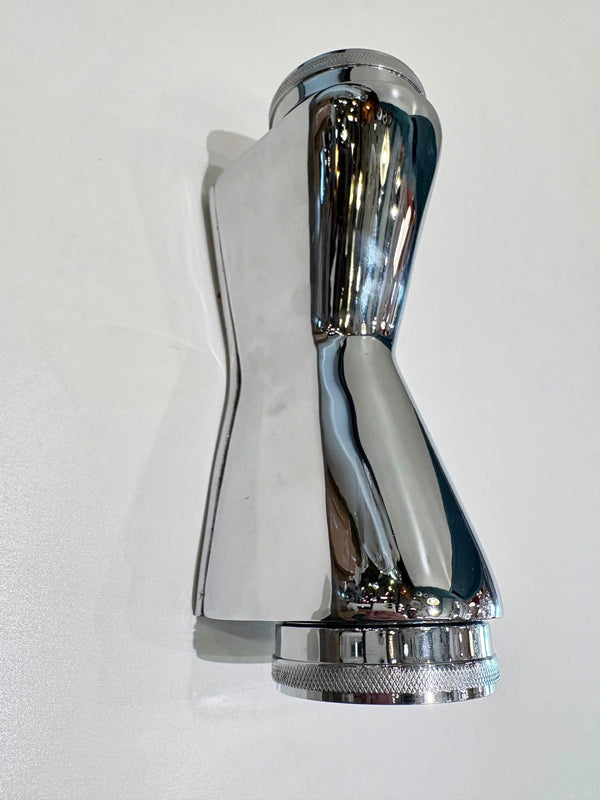
FIENO: brass with a curved middle and a slim waist, so it looks softer than a plain cylinder. Rated IP54 for covered outdoor areas and bathrooms, with two GU10 sockets for LED bulbs up to 4W. It is about 9 inches tall, 3.3 inches wide and 4 inches deep (23 x 8.5 x 10 cm).
All three are handmade and can be ordered in different finishes. In raw brass, the surface is left unvarnished and develops a patina over time; other finishes are varnished. See the full range in our up and down outdoor wall lights collection, or browse modern cast brass outdoor lights.
Frequently asked questions
Do up and down lights give enough light for a front door?
They give enough light to find the step and the lock, and they make the entry look welcoming, but they are softer than a light that faces you. For a dark entry, use a pair, one on each side of the door, or combine them with a ceiling light in the porch.
How far apart should up and down wall lights be?
On most single-story facades, 6 to 8 feet (1.8 to 2.4 m) works well; on taller walls, 8 to 10 feet (2.4 to 3 m) with narrower beams. Line them up with windows, piers or other features so the spacing looks deliberate.
Can up and down lights be used on an exposed wall?
Yes, if they are rated IP64 or higher. The upward opening faces the sky, so a fixture rated only IP44 or IP54 is better kept under a roof or on a sheltered wall.
Can I use up and down lights in a bathroom?
Yes, outside the shower zone, as long as the fixture is rated at least IP44. FIENO is rated IP54 and is designed for both bathrooms and covered outdoor areas.
Will brass up and down lights change color outdoors?
Raw, unvarnished brass reacts with air and moisture and slowly darkens into a patina. If you prefer the original look, ask for a varnished finish. Our brass care guide explains both options.
Related reading
- Shop up and down outdoor wall lights
- All outdoor lights
- The best brass outdoor wall lights
- How high to mount outdoor wall lights
- Gooseneck outdoor lights guide
Handmade brass lighting · Crafted in Istanbul · Free US shipping · Arel Lighting