
Artikel: Victorian Wall Sconces (2026): Styles, Finishes & How to Choose
Victorian Wall Sconces (2026): Styles, Finishes & How to Choose
Quick answer: A Victorian wall sconce is defined by ornate cast metal (usually brass), curved or candle-style arms, and decorative glass: etched, fluted, frosted or stained. To get the look right, choose solid brass in an antique or unlacquered finish, pair it with candle-style or filament bulbs at 2200K to 2700K, and mount it in pairs. Tiffany-style stained glass sconces belong to the very end of the era and suit the same rooms.
Arel Lighting casts its traditional sconces by hand in brass, and Victorian designs are some of the most searched-for pieces in our catalog. This guide explains what actually makes a wall sconce "Victorian," how to tell an authentic-looking reproduction from a cheap imitation, which finishes and bulbs work, and where these sconces look best in an American home, from Queen Anne row houses to modern rooms that need a little history.
What makes a wall sconce "Victorian"?
A wall sconce reads as Victorian when it combines three things: ornate cast metalwork, arms that recall candles or gas jets, and decorative glass. The Victorian era ran from 1837 to 1901, and for most of it homes were lit by candles, oil and, later, gas. Fixtures from that period were designed around a flame, which is why Victorian-style sconces still have upturned arms, candle cups and shades that open upward.
The details that give it away:
- Cast or stamped brass with scrolls, leaves, flowers or figures. The decoration is part of the metal itself, not printed on.
- One or two curved arms, often in a swan-neck or S-curve, rising from a decorative backplate.
- Glass shades that are etched, fluted, frosted or colored, rather than plain fabric or clear modern glass.
- Candle-style sockets, sometimes with faux drip candle sleeves, that echo the original candle and gas fixtures.
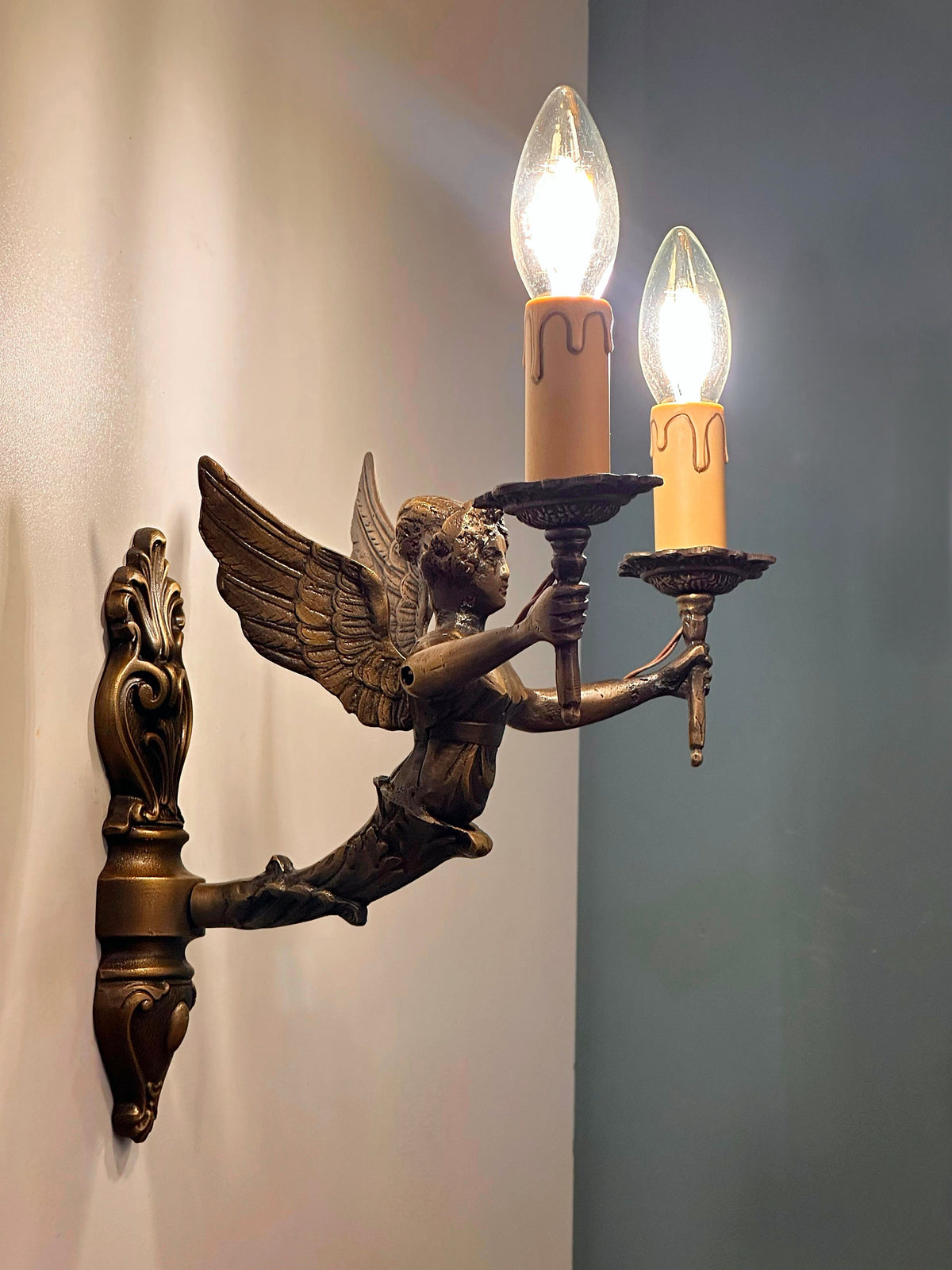
Our DREUX sconce shows all of these at once: a hand-cast brass figure with outstretched wings holding two candle-style arms.
What are the main styles of Victorian wall sconce?
Victorian lighting covers more than six decades, so there isn't a single look. These are the styles you'll see most often in reproductions today:
| Style | What it looks like | Best for |
|---|---|---|
| Candle-arm sconce | One or two brass arms ending in candle cups; bare candle bulbs or small shades | Hallways, flanking a fireplace or mirror |
| Gas-style sconce | An upturned arm with a tulip or bell glass shade, modeled on gas fixtures | Living rooms, staircases |
| Figural sconce | Cast brass figures, cherubs, animals or foliage holding the lights | Statement walls, entryways |
| Shaded dual-arm sconce | Two curved arms with fabric or glass shades over a cast backplate | Bedrooms, dining rooms |
| Tiffany-style stained glass | A leaded, jewel-toned glass shade on a brass arm; a late-Victorian and Art Nouveau look | Reading corners, studies, bedrooms |
If you like the shaded look, the ROANNE pairs a cast brass body with two curved arms and shades. For stained glass, see the CORUCHE TIFFANY III and the CAPO BLUE TIFFANY III.
Is a Tiffany sconce Victorian?
Partly. Leaded stained glass lamps were popularized by Tiffany Studios in New York at the very end of the Victorian era, around the 1890s and early 1900s, and the style overlaps with Art Nouveau. Today "Tiffany-style" means any leaded, multicolored glass shade made in that tradition. It sits comfortably in a Victorian interior because it shares the same love of rich color, handcraft and warm, low light, but it is a lighter, more organic look than the heavy cast brass of earlier Victorian fixtures.
A practical tip: stained glass throws colored light rather than bright white light. Use a Tiffany-style sconce for atmosphere and accent, and don't rely on it as the main light for a task like reading or shaving.
How do you tell a good Victorian reproduction from a cheap one?
The biggest difference is what the fixture is made of. Many "Victorian" sconces sold online are zinc or steel with a thin brass-colored coating. They look similar in photos, but the detail is shallow and the finish wears or flakes, especially in bathrooms. Check for these signs of quality:
- Solid brass or cast brass named on the spec sheet, not "brass finish" or "brass color."
- Weight. Cast brass is heavy for its size; a light fixture is usually plated.
- Crisp casting detail. Leaves, scrolls and figures should have depth and sharp edges, not soft, rounded shapes.
- Real glass. Etched, fluted or stained glass, rather than plastic or printed patterns.
- A finish that can age. Antique or unlacquered brass develops a patina over time, which is exactly the look Victorian rooms need. Our guide to antique vs modern brass explains how each finish changes.
Which finish and bulbs suit a Victorian sconce?
Finish: Antique brass is the safest choice; it looks aged from day one. Unlacquered (raw) brass starts bright and darkens naturally over months, which many owners prefer because it ages like an original. Polished brass is historically accurate too, but it shows fingerprints and needs polishing to stay bright. Black and nickel finishes read as more modern and lose some of the period character.
Bulbs: Victorian light was warm and low. Aim for:
- 2200K to 2700K color temperature, the warm amber of candle and gas light.
- Candle-shaped (torpedo) or filament LED bulbs, often with a E12 candelabra base in the US for candle-style arms. Check each fixture's socket; some use E26.
- A dimmer. Victorian rooms look best with layered, dimmable light rather than one bright overhead source.
Our color temperature guide covers bulb choice in more detail.
Where do Victorian wall sconces work best?
Victorian sconces are at their best where you want warmth and a sense of history:
- Hallways and staircases. A row of candle-arm or gas-style sconces is the classic Victorian way to light a long space.
- Flanking a fireplace or mirror. Mount them as a pair, an equal distance from the center line.
- Bedrooms. Shaded dual-arm sconces on either side of a bed free up nightstand space and give a soft glow.
- Dining rooms. Sconces on the side walls add warmth around a chandelier.
- Powder rooms. A pair of brass sconces beside a vanity mirror gives a period look. For full bathrooms, check the damp rating first.
They also work in modern homes. A single figural or stained glass sconce on a plain wall becomes a focal point, and the contrast with clean modern furniture often looks more intentional than a fully period room.
How high should you hang a Victorian wall sconce?
Most wall sconces sit with their center around 60 to 72 inches from the floor, roughly at eye level, so the light falls below your sightline. With Victorian sconces, two adjustments help. Upturned candle and gas-style arms can be hung a few inches lower, because the bulbs face upward. Sconces with heavy shades or tall backplates usually look better a few inches higher. When flanking a mirror or fireplace, keep both at exactly the same height. See our full wall sconce height guide for room-by-room measurements.
How do you care for a brass Victorian sconce?
Dust with a soft, dry cloth and wipe glass shades with a damp cloth when the power is off. For antique and unlacquered brass, decide whether you want the patina to deepen or stay bright. If you prefer it bright, polish occasionally with a brass cleaner; if you like the aged look, just dust and leave it. Avoid abrasive pads, which scratch fine casting detail. Our brass cleaning and patina guide walks through both approaches.
Frequently asked questions
What is the difference between Victorian and Art Deco sconces?
Victorian sconces (1837–1901) are ornate and organic: scrolls, foliage, figures and candle-style arms. Art Deco sconces (1920s–1930s) are geometric: fans, stepped shapes, straight lines and frosted or fluted glass. Victorian feels romantic and traditional; Art Deco feels sleek and glamorous.
Can I use Victorian sconces in a modern home?
Yes. One or two period pieces against a plain, modern backdrop often look more striking than a fully Victorian room. Choose a finish that ties into something else in the room, such as brass hardware or a gold picture frame.
Do Victorian sconces need special bulbs?
No special technology, but the bulb shape matters for the look. Candle-style LED bulbs with an E12 candelabra base suit candle arms; filament bulbs suit open or clear-glass shades. Keep the color temperature at 2700K or warmer.
Are Victorian sconces hardwired?
Most are designed to be hardwired to a wall junction box. If you don't have wiring in place, have a licensed electrician add a box, or choose a plug-in model.
Is antique brass the same as old brass?
No. "Antique brass" is a finish that makes new brass look aged. True old brass gets its color from decades of natural patina. Unlacquered brass is the in-between option: it starts bright and ages naturally in your home.
Related reading
- Shop traditional wall sconces
- Antique vs modern brass sconces
- How high to hang wall sconces
- How to clean brass lighting and manage patina
Hand-cast brass · Traditional and Victorian designs · Free US shipping · Arel Lighting
,%20curved%20or%20candle-style%20arms,%20and%20decorative%20glass:%20etched,%20fluted,%20frosted%20or%20stained.%20To%20get%20the%20look%20righ...)