Appliques murales en laiton : le guide complet de l'acheteur pour les maisons au Royaume-Uni en 2026
Arel Lighting fabrique artisanalement des appliques murales en laiton à Istanbul, et ce guide couvre tout ce que les propriétaires britanniques doivent savoir avant d'acheter : la différence entre le laiton massif et le laiton plaqué, quels styles conviennent aux maisons d'époque ou modernes, combien dépenser, et comment éviter les erreurs qui font qu'un luminaire paraît inapproprié au bout de deux ans.
Qu'est-ce qu'une applique murale en laiton ?
Une applique murale est un luminaire fixé directement au mur, alimenté par le câblage mural plutôt que par un plafonnier. Les appliques murales en laiton utilisent du laiton massif ou du métal plaqué laiton pour le corps, le bras et la rosace. Au Royaume-Uni, elles sont le plus souvent installées dans les couloirs, salons, chambres et salles de bains (où un indice IP44 minimum est requis en Zone 2 selon la norme BS 7671). Les maisons en rangée victoriennes et géorgiennes conviennent particulièrement aux designs traditionnels en laiton, bien que les finitions contemporaines brossées ou satinées fonctionnent aussi dans les intérieurs modernes.
Types d'appliques murales en laiton : quel style convient à votre maison ?
Appliques traditionnelles en laiton avec abat-jour en tissu
Un bras en laiton s'étend depuis le mur et se termine par un porte-lampe enveloppé d'un abat-jour en tissu — généralement en lin, coton ou soie cousue à la main. L'abat-jour diffuse la lumière de l'ampoule en une lumière chaude et ambiante d'environ 300 à 500 lumens par luminaire. Dimensions standard : 25 à 45 cm de hauteur, 15 à 25 cm de projection du bras. C'est le choix approprié pour les couloirs, salons et chambres de style victorien et édouardien. Recherchez des abat-jours cousus à la main et une construction en laiton massif — une fine plaque de laiton sur aluminium se déforme à l'installation et ternit de manière inégale en 3 à 5 ans.
Appliques à ampoule nue et cage
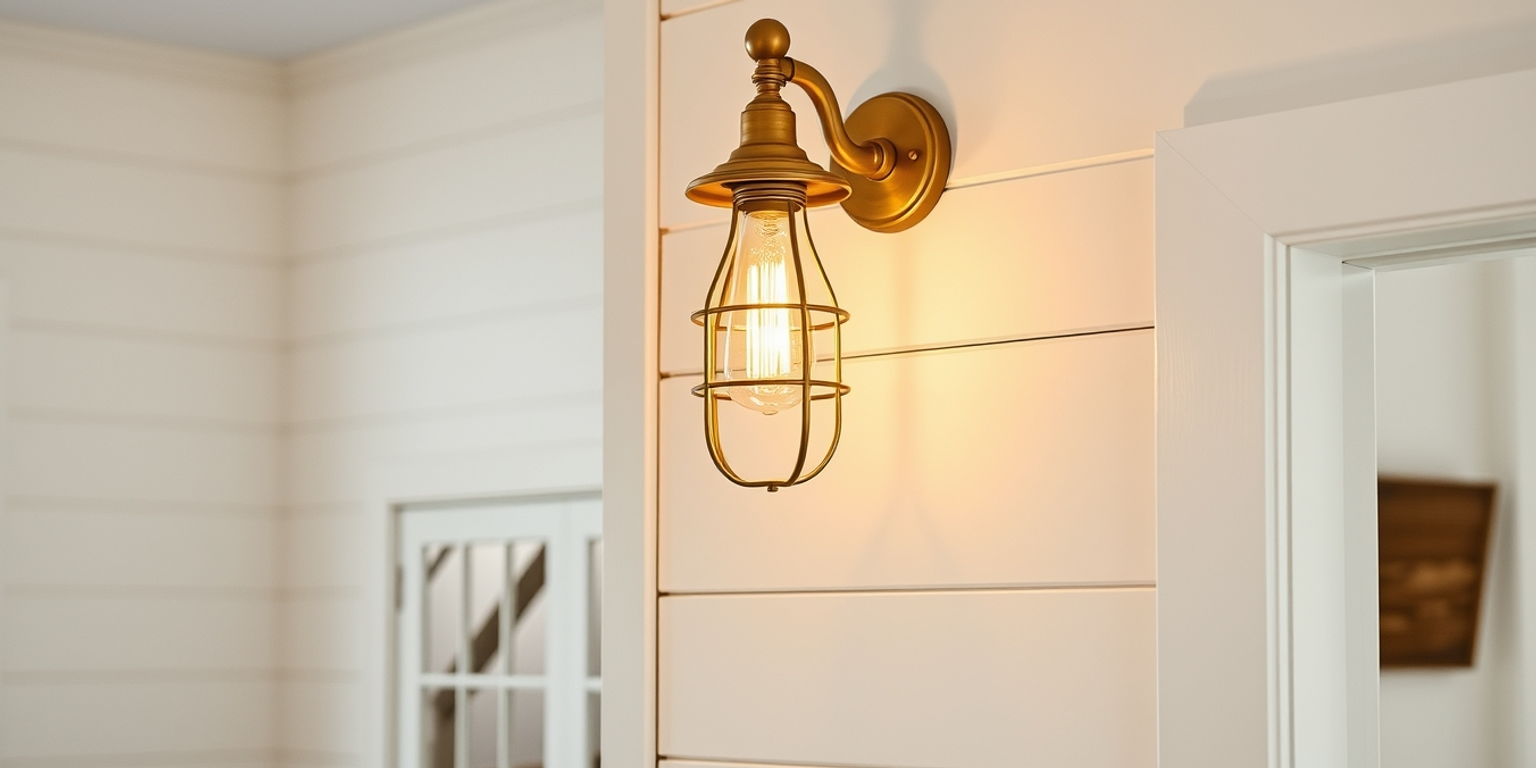
Un protège-lampe ou un support ouvert expose directement l'ampoule, offrant une esthétique industrielle ou nautique. Les modèles en laiton brut conviennent aux cuisines, salles de bains, maisons côtières et salles à manger de style pub. Ils sont généralement plus compacts : 20 à 35 cm de hauteur, 12 à 18 cm de projection. Ils utilisent des ampoules à filament Edison E27 grandes — un globe G95 ou G125 de 4W LED (équivalent à 40W incandescent) produit 350 à 470 lumens avec une température de couleur chaude de 2200K qui s'accorde avec la finition en laiton brut.
Appliques en céramique et laiton coulé
Les appliques traditionnelles haut de gamme combinent des éléments en céramique — un corps ou une plaque arrière en céramique — avec une quincaillerie en laiton. Le contraste entre la céramique blanche ou crème et le laiton crée une esthétique campagnarde française ou classique anglaise. Ce sont des fixations plus lourdes : généralement entre 800 g et 1,2 kg, nécessitant des fixations murales solides capables de supporter une force de traction d'au moins 2 kg. Adaptées aux propriétés d'époque, aux hôtels-boutiques et aux intérieurs où la fixation doit être une déclaration de design.
Appliques en laiton coulé Art Déco
Le laiton coulé — versé dans des moules plutôt que pressé à partir de tôle — produit des appliques avec beaucoup plus de détails de surface et de masse que les fixations pressées. Les designs Art Déco présentent des détails géométriques en marches, des formes d'éventail ou des motifs en rayons de soleil. Une applique en laiton coulé de qualité pèse entre 800 g et 1,2 kg : ce poids est un indicateur précis de la quantité de laiton utilisée. Ces appliques conviennent particulièrement aux propriétés d'époque, aux restaurants et à tout espace où l'éclairage doit aussi servir de sculpture.
Laiton massif vs plaqué laiton : la distinction la plus importante
Le laiton massif est du laiton à part entière. On le raye — c'est toujours du laiton. Les fixations plaquées laiton ont une couche de 5 à 25 microns de laiton sur un alliage de zinc, aluminium ou acier. Le placage s'use aux bords, aux points de fixation et partout où la surface est fréquemment touchée. Dans une salle de bain ou près d'une porte d'entrée — où l'humidité et l'air salin accélèrent la corrosion — le placage en laiton montre généralement des signes d'usure en 2 à 5 ans. Le laiton massif coûte plus cher à l'achat mais est en fait un achat unique : une applique de qualité en laiton massif durera plus longtemps que tout autre matériau dans une installation domestique. Arel Lighting utilise du laiton massif pour tout — corps, bras, rosace et plaque arrière.
Laiton laqué vs laiton non laqué
Le laiton laqué possède un revêtement protecteur clair qui maintient la finition brillante et statique. Le laiton non laqué (vivant) n'a pas de revêtement et développe une patine — s'assombrissant et s'approfondissant au fil des mois et des années. La plupart des pièces artisanales et des reproductions victoriennes utilisent du laiton non laqué car la patine est essentielle : la fixation paraît plus authentique après cinq ans qu'au premier jour. Le laiton vendu dans le commerce de masse est presque toujours laqué pour plus de régularité. Aucune finition n'est objectivement meilleure — si vous souhaitez assortir une quincaillerie de porte d'époque existante (poignées en laiton non laqué, boîtes aux lettres, charnières), l'éclairage non laqué s'accordera mieux car les deux vieillissent ensemble.
Type d'ampoule : B22 vs E27
B22 (douille à baïonnette) est la douille domestique standard au Royaume-Uni — celle que l'on trouve dans la plupart des rosaces de plafond et lampes de table britanniques. E27 (grosse vis Edison) est utilisée en éclairage décoratif car elle accepte des ampoules plus grandes et visuellement intéressantes. Les deux sont largement disponibles en équivalents LED. Choisissez E27 si vous souhaitez de grosses ampoules à filament comme élément visuel (ampoule nue et designs en cage). Choisissez B22 si vous voulez la plus large gamme d'ampoules LED standard britanniques et des remplacements faciles dans n'importe quel supermarché ou magasin de bricolage.
Câblage : câblé vs à brancher
Les appliques câblées sont connectées en permanence au câblage mural sans câble visible. Elles nécessitent un électricien qualifié enregistré Part P si vous ajoutez un nouveau circuit, prolongez une dérivation ou installez dans une salle de bain ou une cuisine. Le remplacement d'un luminaire similaire sur un circuit existant ne nécessite pas d'électricien certifié selon Part P, bien qu'une installation électrique compétente soit requise. Les appliques à brancher ont un câble visible allant à une prise standard 13A — pas besoin d'électricien, mais le câble traînant peut paraître désordonné. Pour une installation finie et permanente dans une propriété ancienne, le câblage fixe est la bonne solution.
Indice de protection (IP) pour les salles de bain
Selon la norme BS 7671 (réglementation électrique britannique), les zones de la salle de bain sont définies comme suit. Zone 1 : directement au-dessus de la baignoire ou de la douche, jusqu'à 2,25 m de hauteur — IP45 minimum requis. Zone 2 : rayon horizontal de 60 cm au-delà de la zone 1, ou au-dessus de la zone 1 au-delà de 2,25 m — IP44 minimum requis. Hors zones : aucune exigence IP légale, bien que IP20 ou plus soit recommandé pour la résistance générale à l'humidité. La plupart des appliques décoratives en laiton conçues pour la salle de bain ont un IP44 standard — vérifiez toujours la classification IP avant d'acheter et d'installer dans une salle de bain.
Guide des prix
Moins de 80 £ par applique
À ce niveau de prix, une construction en laiton massif est essentiellement indisponible chez les fournisseurs réputés. Vous achetez une plaque de laiton sur un alliage de zinc ou d'aluminium. La finition semblera convaincante pendant 1 à 3 ans et montrera des signes d'usure aux bords et aux points de fixation dans les 3 à 5 ans. Raisonnable pour les locations ou les installations temporaires. Pas le bon choix pour une maison que vous souhaitez conserver.
80 £–200 £ par applique
C'est ici que le laiton massif devient accessible. Toute la gamme d'Arel Lighting se situe dans cette catégorie — corps en laiton massif, finition à la main, avec une garantie fabricant de 3 ans et une livraison gratuite au Royaume-Uni. Pour la plupart des propriétaires britanniques installant 2 à 4 appliques dans un couloir ou une chambre, c'est le niveau d'investissement approprié : une qualité qui s'améliore avec le temps, sans se dégrader.
£200–£500+ par applique
À ce niveau, vous achetez auprès d'artisans indépendants britanniques ou européens, commandez des travaux sur mesure ou achetez auprès de marques d'éclairage patrimoniales. La différence de qualité des matériaux par rapport à la fourchette £80–£200 est marginale — le laiton massif reste du laiton massif. Le supplément paie la provenance, les dimensions personnalisées et les options de finition sur mesure.
Conseils pièce par pièce
Couloirs
Largeur standard des couloirs au Royaume-Uni : 1,0–1,8 m. Hauteur standard sous plafond : 2,4 m. Montez les appliques à 155–165 cm du sol jusqu'au centre du luminaire — environ à hauteur des yeux — pour que la lumière éclaire l’espace sans créer d’éblouissement vers le haut. Une paire (une applique de chaque côté) pour 4 m de longueur de couloir. Pour les couloirs de moins de 1,2 m de large, utilisez des appliques avec une projection inférieure à 18 cm pour éviter toute intrusion à hauteur du visage. Les modèles traditionnels en laiton avec abat-jour en tissu sont le choix approprié : ils créent une ambiance chaleureuse sans ombres dures.
Salles de bain
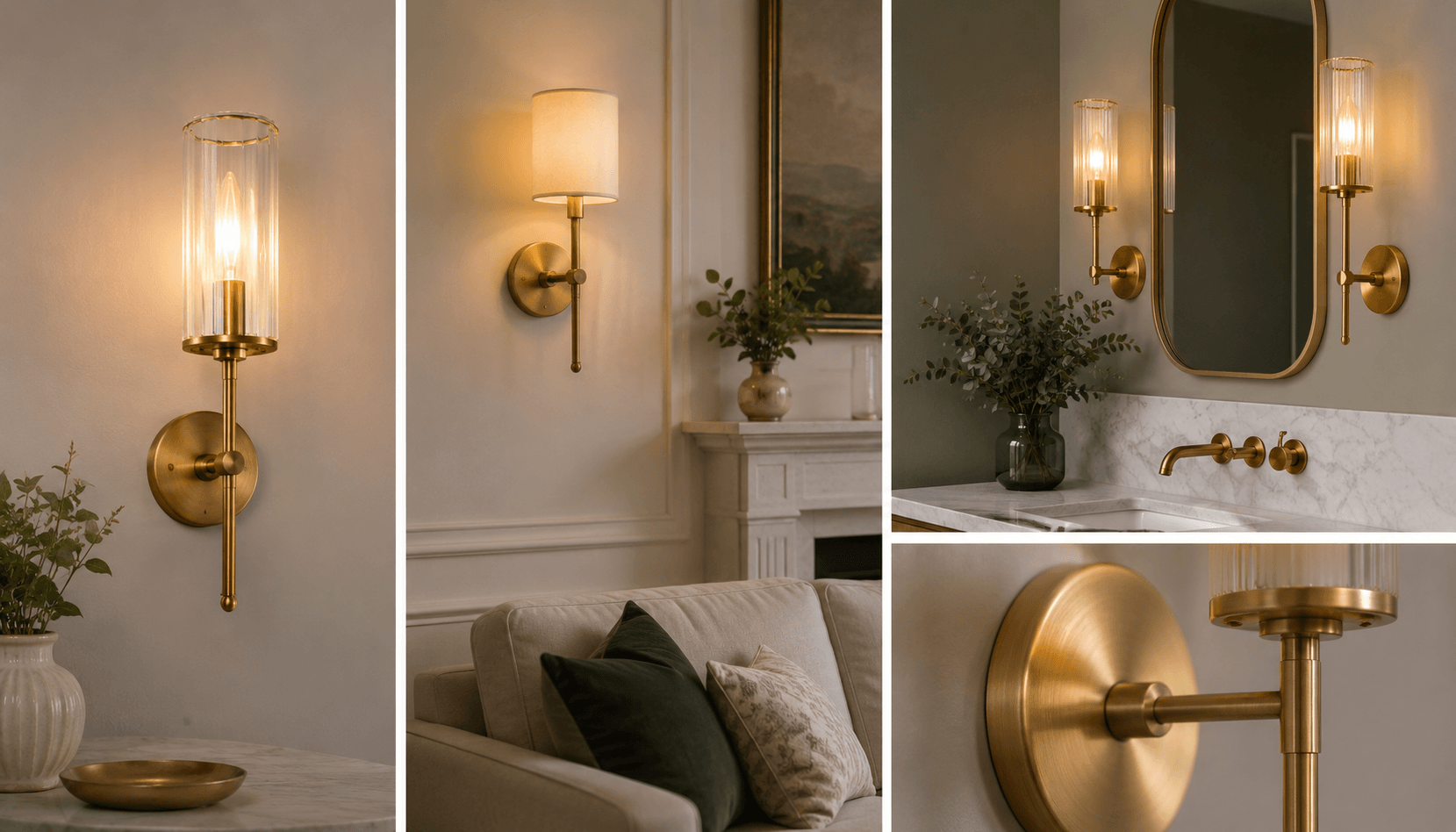
Installez les appliques de chaque côté du miroir de la salle de bain à une hauteur de 155–165 cm — pas au-dessus. L'éclairage au plafond crée des ombres sous les yeux ; l'éclairage latéral les élimine. Espacement : 90–100 cm centre à centre pour un miroir standard de 60–80 cm. Pour les doubles vasques ou les miroirs plus grands, augmentez l'espacement proportionnellement. Vérifiez un indice IP44 minimum pour un positionnement en Zone 2 avant l'achat.
Chambres
Les appliques murales de chevet remplacent entièrement les lampes de table et libèrent la surface de la table de nuit. Montez-les à 120–130 cm du sol si vous prévoyez de lire au lit avec des oreillers derrière vous — cela place la source lumineuse à peu près à la hauteur des épaules en position assise. Utilisez des circuits à interrupteurs indépendants (un de chaque côté) pour que chaque personne contrôle sa propre lumière. Les appliques avec abat-jour en tissu à une température de couleur de 2700K sont adaptées aux chambres : lumière chaude, diffuse, douce pour les yeux la nuit.
Questions fréquemment posées
Les appliques murales en laiton conviennent-elles aux maisons victoriennes et géorgiennes ?
Oui — les appliques murales en laiton sont appropriées pour les propriétés de l'époque victorienne (1837–1901) et géorgienne (1714–1830). Les supports à gaz et les premiers luminaires électriques de cette époque étaient fabriqués en laiton, en fonte ou en métaux dorés. Une applique traditionnelle en laiton est l'un des choix d'éclairage les plus architecturaux et fidèles pour un couloir d'époque. Évitez les finitions chrome, nickel brossé et noir mat dans les pièces où vous souhaitez préserver un caractère d'époque.
Ai-je besoin d'un électricien pour installer des appliques murales au Royaume-Uni ?
Remplacement d'un luminaire identique sur un circuit existant : aucun électricien requis selon la Partie P, bien qu'une compétence en bricolage électrique soit attendue. Ajout d'un nouveau circuit, déplacement d'un dérivation existante ou installation dans une salle de bains ou douche : un électricien enregistré Partie P est légalement requis. Les appliques à brancher sur une prise standard 13A ne nécessitent aucun travail électrique.
Comment nettoyer les appliques murales en laiton sans les abîmer ?
Laiton laqué : essuyez avec un chiffon humide et un savon doux, puis séchez immédiatement. N'utilisez pas de nettoyants abrasifs — ils rayent le laquage et exposent le laiton nu à l'oxydation. Laiton non laqué : même méthode pour le nettoyage courant. Pour restaurer la brillance, utilisez un polish spécial laiton (Brasso, Bar Keepers Friend ou similaire) appliqué avec un chiffon doux, puis lustrez. Beaucoup de propriétaires de laiton non laqué le laissent vieillir naturellement — c'est le comportement prévu du matériau.
Quelles ampoules LED conviennent le mieux aux appliques murales en laiton ?
Les ampoules LED à filament avec une température de couleur de 2200K à 2700K sont le choix idéal pour les appliques en laiton en 2026. Elles reproduisent la lueur ambrée chaude des ampoules à incandescence, consomment 80 à 90 % moins d'énergie et durent de 15 000 à 25 000 heures. Évitez les LED blanc froid (4000K+) ou lumière du jour (6500K) — la température de couleur contraste avec les finitions chaudes du laiton et donne un aspect clinique plutôt qu'atmosphérique. Pour les modèles à ampoule nue ou cage, utilisez une ampoule LED à filament globe G95 ou G125 de 4 à 6 W — la grande forme de l'ampoule devient un élément visuel à part entière.
Combien d'appliques murales me faut-il pour un couloir ?
Une paire (deux appliques, une de chaque côté) pour les couloirs jusqu'à 4 m de long. Deux paires pour 4 à 8 m. Trois paires ou plus, espacées régulièrement, pour les couloirs de plus de 8 m ou les couloirs en L. Espacement maximal entre les paires : 2,5 m, pour éviter les zones d'ombre. Pour les couloirs de moins de 1,0 m de large, envisagez une seule rangée sur un mur uniquement — la symétrie sur les deux murs dans un espace très étroit peut donner une impression d'enfermement plutôt que d'élégance.
La livraison gratuite au Royaume-Uni est-elle disponible pour les appliques murales en laiton Arel ?
Oui — Arel Lighting livre gratuitement à toutes les adresses du Royaume-Uni pour chaque commande, sans minimum d'achat. La livraison prend 4 à 8 jours ouvrables via un service de messagerie suivi. Toutes les appliques Arel bénéficient d'une garantie fabricant de 3 ans et sont fabriquées à la main à Istanbul en laiton massif.
Publié par
Équipe éditoriale d'Arel Lighting
Chaque guide est élaboré en se basant sur les spécifications des fabricants, les normes de câblage britanniques (BS 7671) et les connaissances actuelles du marché. Arel Lighting fabrique à la main des appliques murales en laiton massif à Istanbul et les livre gratuitement au Royaume-Uni.
À propos de Arel Lighting · Acheter des appliques murales en laiton