Adjustable Outdoor Spotlights (2026): How to Uplight Trees, Facades & Gardens
Quick answer: An adjustable outdoor spotlight has a head you can tilt or rotate, so you can aim a beam at a tree, a wall, a sculpture or a path. For uplighting, place a spike light about 1 to 3 feet (30 to 90 cm) from a tree trunk or 1 to 2 feet (30 to 60 cm) from a wall, use warm 2700K to 3000K LED bulbs, pick a narrow beam for tall, slim targets and a wider beam for broad canopies, and choose IP64 or higher for fixtures that sit in open ground or take direct rain.
Most gardens disappear after dark. A few well-aimed spotlights change that: a lit tree gives the yard depth, a grazed wall shows off stone or brick, and a small accent on a planter or sculpture gives the eye somewhere to rest. Adjustable fixtures are the tool for the job because you can fine-tune the angle after installation, as plants grow and seasons change. This guide covers the main types, how far to place them from what you are lighting, which beam and bulb to use, and which IP rating you need.
What is an adjustable outdoor spotlight?
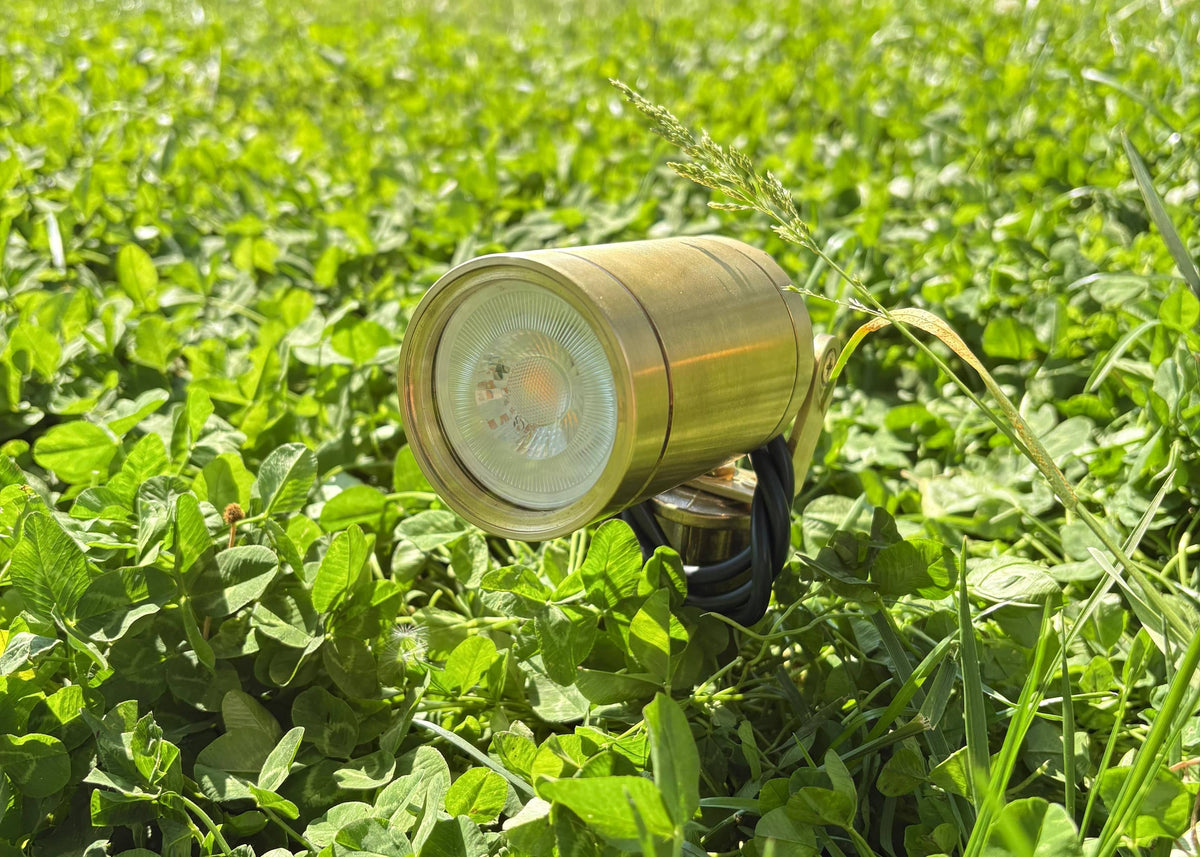
It is a compact outdoor fixture with a directional head, usually holding a single bulb such as a GU10 LED. The head tilts, rotates or bends so the beam can be aimed precisely, instead of glowing in every direction like a lantern or bulkhead light. There are three common forms:
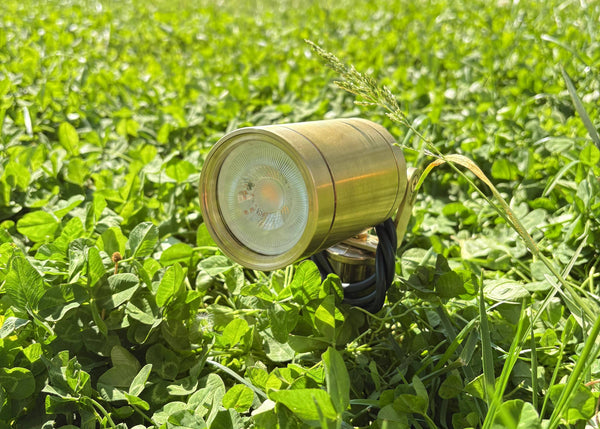
- Spike spotlights push into soil or a lawn on a ground stake. They are the classic landscape uplight for trees, shrubs and garden walls.
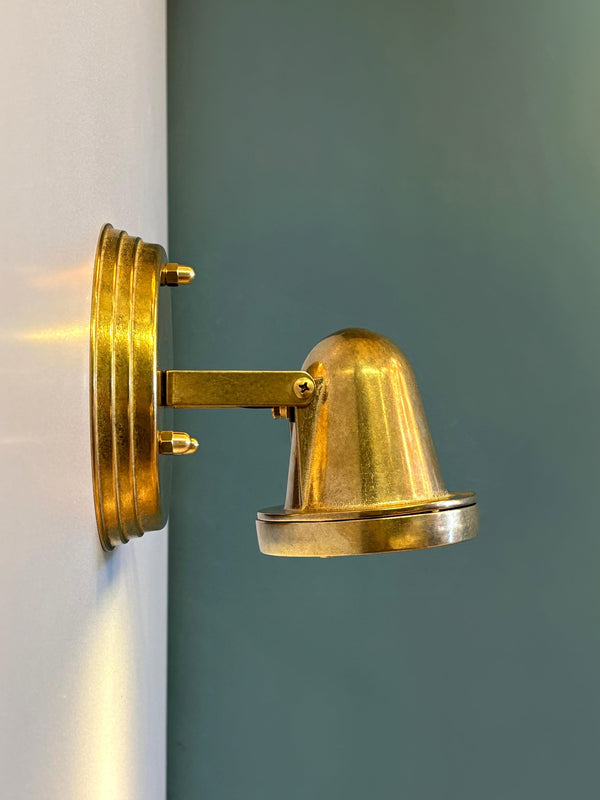
- Wall-mounted adjustable spotlights fix to a facade, fence or post and aim down at a path, across a wall, or up at a feature.
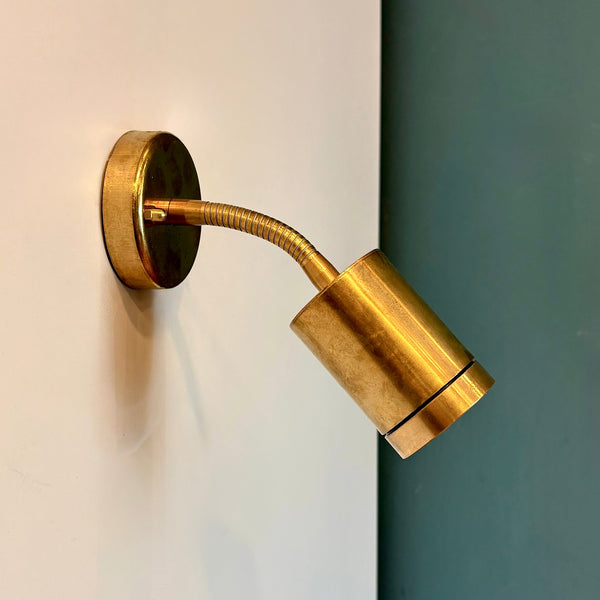
- Flexible-arm lights use a gooseneck you can bend, which is useful where you need to reach past a ledge, a sign or a planter.
Spike light, wall spotlight or flexible arm: which one do you need?
| Type | Best for | Mounting | Things to know |
|---|---|---|---|
| Spike spotlight | Trees, shrubs, garden walls, sculptures, flower beds | Pushed into soil, gravel beds or lawn | Easy to move as plants grow; cable must be run and protected underground |
| Wall-mounted adjustable spotlight | Paths, steps, entrances, facade details, climbing plants | Fixed to a wall, fence or post over a junction box | Light comes from above, so it doubles as practical lighting |
| Flexible-arm (gooseneck) light | Signs, house numbers, planters, boat decks, seating areas | Fixed to a wall or surface | Arm lets you reach out and aim around obstacles |
Many gardens use a mix: spike lights for trees and planting, and a couple of wall spotlights near the house where you also need to see the steps.
How do you uplight a tree?
Uplighting a tree means placing a spotlight at the base and aiming the beam up through the trunk and canopy. It is the single most effective landscape lighting move, because a lit tree reads from inside the house and from the street.
- Slim or columnar trees (cypress, birch, young ornamentals): one fixture, 1 to 2 feet (30 to 60 cm) from the trunk, with a narrow beam of about 15 to 25 degrees so the light travels all the way up.
- Medium trees with a spreading crown: two fixtures on opposite sides, about 2 to 3 feet (60 to 90 cm) from the trunk, with medium beams of about 25 to 40 degrees.
- Large, wide trees: two or three fixtures placed under the canopy, part way between the trunk and the drip line, aimed up into the branches. This shows the structure of the tree rather than just the trunk.
- Textured bark (oak, olive, palm): bring the light closer to the trunk, around 1 foot (30 cm), so the beam grazes the bark and picks out its texture.
Aim from the side people usually see the tree from, and tilt the head slightly away from the main viewpoint so nobody looks straight into the bulb. Revisit the aim once a year; trees grow and branches that were lit last summer may be in shadow now.
How do you light a facade or garden wall with spotlights?
There are two techniques. Grazing places the light close to the wall, about 6 to 12 inches (15 to 30 cm) away, with a narrow beam aimed straight up. The light hits the surface at a shallow angle and every joint in brick or stone casts a small shadow. Washing moves the light further back, about 2 to 3 feet (60 to 90 cm), with a wider beam, which gives a smoother, more even glow and hides imperfections in render or siding.
For a run of lights along one wall, space spike lights about 6 to 8 feet (1.8 to 2.4 m) apart and keep them the same distance from the wall, so the beams line up. Center them on piers, between windows, or on features you want to show. Avoid aiming straight up at a window, or the beam will shine into the room. For a fixed, wall-mounted alternative, see our guide to up and down outdoor wall lights.
Placement distances at a glance
| Target | Distance from target | Number of lights | Bulb beam |
|---|---|---|---|
| Slim tree or tall shrub | 1 to 2 ft (30 to 60 cm) | 1 | Narrow, 15 to 25 degrees |
| Medium spreading tree | 2 to 3 ft (60 to 90 cm) | 2 | Medium, 25 to 40 degrees |
| Large canopy tree | Under the canopy, part way to the drip line | 2 to 3 | Medium to wide |
| Stone or brick wall (grazing) | 6 to 12 in (15 to 30 cm) | One every 6 to 8 ft (1.8 to 2.4 m) | Narrow |
| Smooth wall (washing) | 2 to 3 ft (60 to 90 cm) | One every 6 to 8 ft (1.8 to 2.4 m) | Wide, 40 to 60 degrees |
| Sculpture, urn or planter | 2 to 4 ft (60 cm to 1.2 m) | 1 to 2, from different angles | Narrow to medium |
These are starting points. The best method is to set the lights out at dusk, switch them on, and move them a few inches at a time until the effect looks right before you bury any cable.
What IP rating do outdoor spotlights need?
The IP rating describes protection against dust (first digit) and water (second digit). Spotlights at ground level face rain, sprinklers, soil and splashing, so they need more protection than a light under a porch roof.
| Location | Suggested rating |
|---|---|
| In open ground, lawns and flower beds | IP64 or higher |
| On an exposed wall or fence | IP64 or higher |
| Under a porch roof, pergola or covered terrace | IP44 or higher |
| Coastal gardens with salt air | IP64 or higher, in a material that will not rust |
Do not bury a spotlight head in soil or mulch, and keep it out of standing water: an IP64 fixture is protected against splashing from any direction, not against being submerged. Our IP ratings guide explains each digit. Near the sea, material matters as much as sealing; solid brass darkens into a patina instead of rusting. More in our coastal durability guide.
Which bulbs work best for landscape spotlights?
- Warm white. 2700K to 3000K suits foliage, bark, brick, stone and brass. Very cool light can make plants look gray. See our color temperature guide.
- LED only. Spotlight heads are compact and enclosed; LED bulbs run cooler and last much longer. Stay within the maximum wattage listed for the fixture.
- Choose the beam by the target. With a GU10 fixture you can change the effect simply by swapping to a narrower or wider bulb, which makes it easy to adjust as plants grow.
- Less is more. A few modest lights with dark space between them look better than a brightly lit yard. Start low and add brightness only where you need it.
Do I need an electrician for outdoor spotlights?
Check the voltage before you buy. Many landscape systems run on low voltage through a transformer, but fixtures with a standard line-voltage socket (110V to 120V in the US) need to be wired like any other outdoor circuit. For line-voltage spotlights, use a licensed electrician, outdoor-rated cable buried at the depth your local code requires, and a GFCI-protected circuit. Plan switching too: a photocell or timer keeps the garden lit only when it should be.
Handmade adjustable outdoor spotlights to consider
VALLADE: a solid brass landscape spike spotlight with an adjustable head, made for uplighting trees, plants, walls and sculptures. Rated IP64 for year-round outdoor use. It takes one GU10 bulb (max 15W; LED recommended) and measures 13.97 inches (35.5 cm) in total length, with a 3.66 inch (9.3 cm) spot, an 8.22 inch (20.9 cm) spike and a 2.36 inch (6 cm) diameter.
TRAIAN: a wall-mounted spotlight cast in brass with cast glass, with an adjustable, rotatable shade so you can aim the light at a path or an architectural detail. Rated IP64, suitable for patios, porches, garden walls and coastal or humid locations. One GU10 bulb (max 15W). It measures 6.29 inches tall, 6.10 inches wide and 7.08 inches deep (16 x 15.5 x 18 cm).
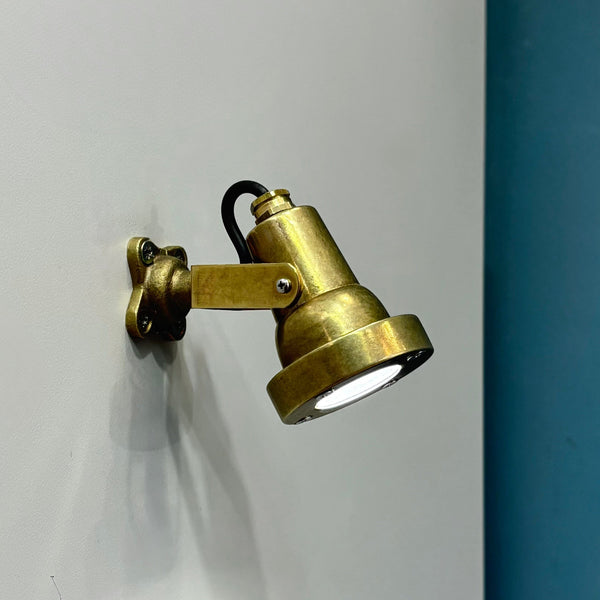
GALATAS: a mini brass casting spotlight whose head moves up and down, useful for picking out small details, steps or planting near the house. Rated IP44, so best on sheltered walls, terraces and entrances. One G9 bulb (max 15W). It measures just 3.54 inches tall, 2.55 inches wide and 4.33 inches deep (9 x 6.5 x 11 cm).
ANECY: a brass wall light on a flexible gooseneck arm with a slim cylindrical shade, so it can be bent and aimed where you want it. Rated IP64, and suited to coastal homes, boats and moisture-prone spaces as well as seating areas. One GU10 bulb (max 15W). The shade is 2.36 inches wide and 3.54 inches tall (6 x 9 cm), with a depth of 8.27 inches (21 cm).
All four are handmade and can be ordered in different finishes. In raw brass the surface is left unvarnished and develops a patina outdoors; other finishes are varnished and keep their look. Bulbs are not included. See the full range in our adjustable outdoor lights collection.
Frequently asked questions
How far from a tree should a spotlight be?
For a slim tree, about 1 to 2 feet (30 to 60 cm) from the trunk with a narrow beam. For a medium spreading tree, use two lights about 2 to 3 feet (60 to 90 cm) out. For a large canopy, place two or three lights under the branches, part way to the drip line, and aim up into the crown.
How many spotlights does a garden need?
Fewer than most people expect. Pick three to five focal points, such as a key tree, a wall, an entrance and a planter, and light those well. Leaving dark areas between them gives the garden depth.
What IP rating do I need for a spike light?
IP64 or higher for anything in open ground, lawns or flower beds. Keep the head above soil and mulch, and away from standing water.
What color temperature is best for landscape lighting?
Warm white, 2700K to 3000K, flatters foliage, bark, stone and brick. Use the same color temperature in every fixture so the garden looks consistent.
Will brass spotlights hold up outdoors?
Solid brass does not rust. Raw, unvarnished brass slowly darkens into a patina; if you prefer the original look, ask for a varnished finish. Our brass care guide covers both.
Related reading
- Shop adjustable outdoor lights
- Up and down outdoor wall lights guide
- IP ratings explained
- Coastal lighting durability guide
- The best brass outdoor wall lights
Handmade brass lighting · Crafted in Istanbul · Free US shipping · Arel Lighting