Outdoor Lanterns & Dock Lamps (2026): How to Light Paths, Gardens & Piers
Quick answer: Use low, caged dock lamps where light needs to sit close to the ground or a deck edge (piers, steps, garden walls, path borders) and wall-mounted lanterns where you need light at door or gate height. For exposed outdoor spots, choose solid brass with an IP64 rating or higher, ribbed or frosted glass to cut glare, and warm LED bulbs around 2700K. Along paths and pier edges, start with fixtures roughly 8 to 10 feet (2.4 to 3 m) apart and adjust after a night test.
Paths, gardens and piers are where outdoor lighting has to work hardest. The fixtures sit low, catch rain and spray, get brushed by plants and feet, and are seen up close. At Arel Lighting we cast our dock lamps and lanterns in solid brass in Istanbul, and most of the questions we get about them come down to the same few things: which shape to use where, how much weather protection is enough, how far apart to place them and what glass to pick. This guide answers each one.
What is the difference between an outdoor lantern and a dock lamp?
Both are classic outdoor shapes, but they do different jobs.
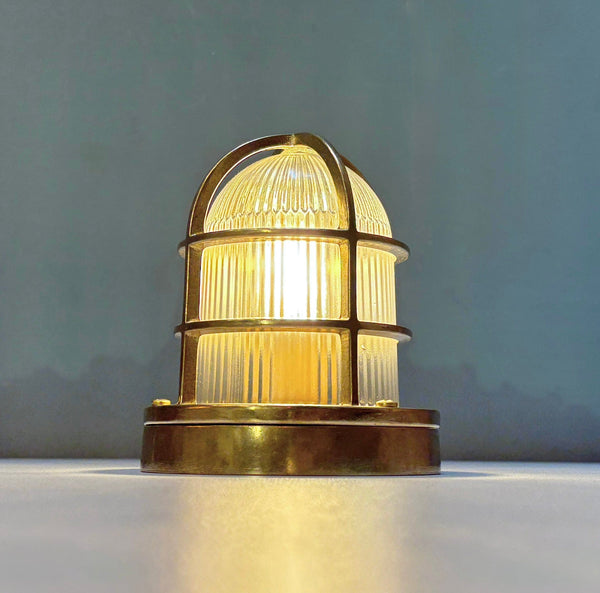
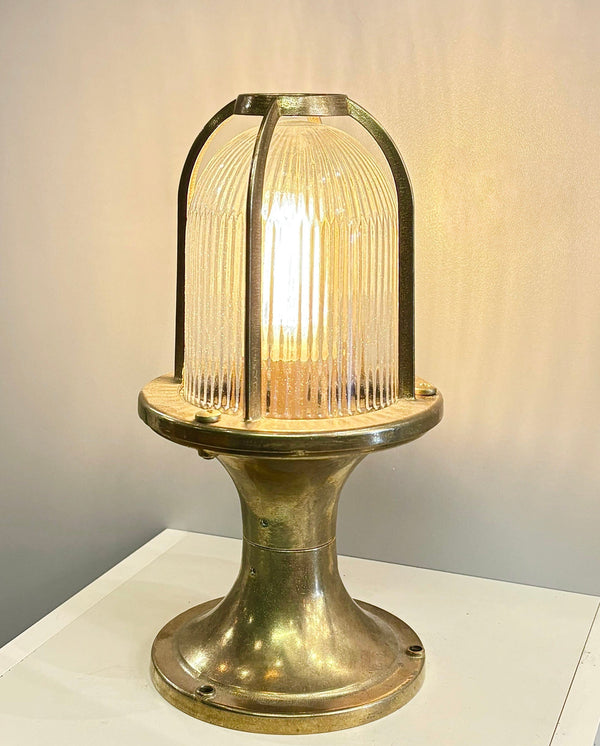
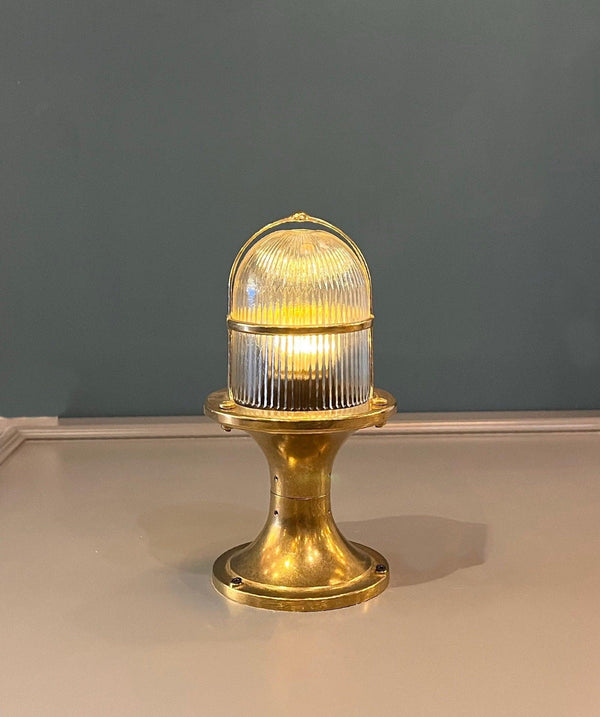
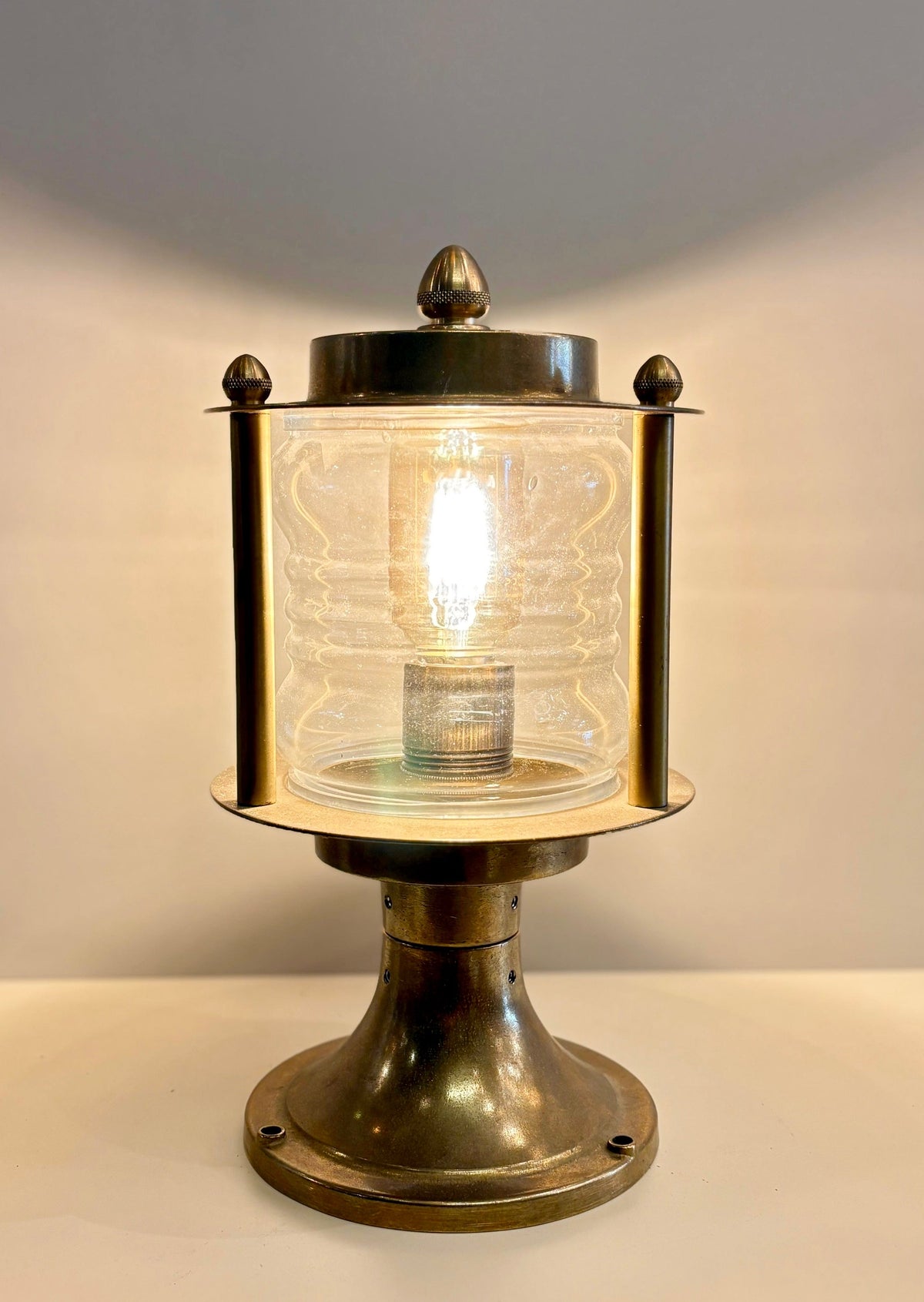
- Dock lamps are compact, heavy fixtures with a glass globe or dome, usually protected by a metal cage. They come from ship decks and piers, where a light has to survive knocks, spray and wind. Today they are used on docks, deck edges, garden walls, pillar tops, steps and path borders, anywhere you want a low, sturdy glow.
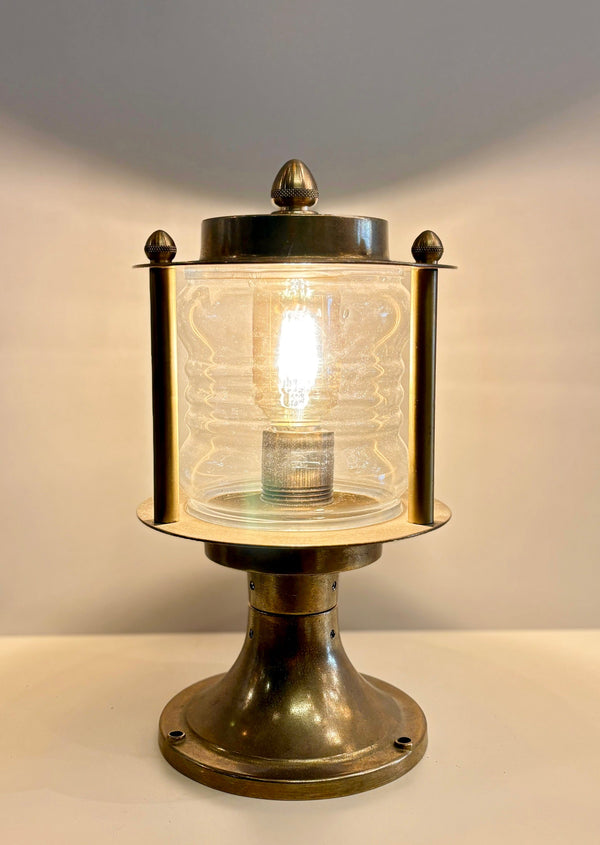
- Outdoor lanterns are taller, more architectural fixtures with glass panels or an open glass enclosure. Most are wall-mounted beside doors, gates and garage openings, where light is needed at head height and the fixture is part of the facade.
Many homes use both: lanterns to mark entries, dock lamps to lead people there.
| Dock lamp | Outdoor lantern (wall) | |
|---|---|---|
| Typical position | Low: deck, pier, wall cap, step, path edge | Door, gate or garage height on a wall |
| Light pattern | Soft pool of light around the base | Wider glow over the door and wall |
| Protection | Cage around the glass guards against knocks | Glass panels or enclosure, often under an eave |
| Best for | Wayfinding, edges, steps, waterfront | Entries, facades, marking a destination |
| Look | Maritime, industrial, compact | Traditional, coastal, architectural |
What IP rating do you need for paths, gardens and piers?
The IP (Ingress Protection) rating tells you how well a fixture resists dust and water. The first digit is solids, the second is water. For low outdoor fixtures, think about how exposed the spot is:
| Location | Exposure | Suggested minimum |
|---|---|---|
| Wall under a deep eave or covered porch | Damp, rarely hit by rain directly | IP44 |
| Open garden wall, path edge, patio | Direct rain, sprinklers, splashing | IP54 to IP64 |
| Pier, dock, boathouse, seafront deck | Rain, spray, wind, salt air | IP64 or higher |
A higher rating does not make a fixture waterproof underwater, so never place low lights where water can pool around them or where they could be submerged at high tide. For a full breakdown of the digits, see our IP ratings guide.
How far apart should path and dock lights be?
The goal along a path or pier is overlapping pools of light, not a runway. Some practical starting points:
- Garden and front paths: about 8 to 10 feet (2.4 to 3 m) apart, staggered on alternating sides on wider paths so the walk does not look like an airstrip.
- Pier and dock edges: about 8 to 12 feet (2.4 to 3.7 m) apart, with an extra light at the end of the pier, at any ladder and where the pier meets the shore.
- Steps: one light at the top and one at the bottom as a minimum; on longer flights, add one every few steps so every tread is visible.
- Pillar tops and gate posts: one fixture per pillar, used in matching pairs either side of an opening.
Fixture height changes the spacing. A lamp around 6 to 7 inches (15 to 17 cm) tall throws a tighter pool than one 11 to 12 inches (28 to 30 cm) tall, so smaller lamps usually sit a little closer together. Before fixing anything permanently, set fixtures out with temporary power or a test lamp at night and walk the route. Adjust until there are no dark gaps at changes in level.
For wall lanterns beside doors, a common guide is to mount the center of the fixture roughly 66 to 72 inches (168 to 183 cm) above the threshold. Our outdoor wall light height guide covers doors, garages and porches in detail.
Which glass works best outdoors: clear, ribbed or frosted?
- Clear glass shows the bulb and gives the most light. It suits lanterns at door height, especially with a filament-style LED bulb. At low level, a bare clear globe can glare into the eyes of anyone walking toward it.
- Ribbed glass breaks the light into lines and hides the bright point of the bulb. It is the traditional choice for dock lamps and works well at path and deck height.
- Frosted or opal glass gives the softest, most even glow and hides the bulb completely, at the cost of some sparkle.
Whatever the glass, warm LED bulbs around 2700K suit brass and planting better than cool white, and lower wattages are usually enough at path level. Our fixtures take standard sockets, so you can try different bulbs before settling. See our color temperature guide for more on Kelvin.
Why solid brass for low outdoor lights?
Low lights take more abuse than wall lights: lawn equipment, garden hoses, salt spray and constant handling. Solid cast brass does not rust the way steel does, and it is heavy enough to feel planted. It does change color outdoors. Raw, unvarnished brass reacts with air and moisture and slowly develops a patina that can look uneven at first before it settles into an aged tone. Varnished finishes keep their original look. On the waterfront, many owners let the patina come in, since it suits the setting. Our salt air durability guide compares materials in more detail, and our brass care guide explains cleaning and patina.
How should low outdoor lights be wired and installed?
- Use a licensed electrician. Outdoor line-voltage wiring, and anything on a dock or near water, has specific code requirements in the US, including GFCI protection. Local rules vary.
- Plan the cable run first. Decide fixture positions, then route cable to each one, rather than placing lights where cable happens to reach.
- Mount on something solid. Dock lamps are heavy and are meant to be fixed to a stable surface: a deck board over framing, a pier cap, a wall top or a pillar.
- Check the canopy or base against the junction box. If it does not cover the box, ask the maker for a different canopy size before installing.
- Use photocells or timers. Path and dock lights are most useful when they come on at dusk without anyone remembering.
Handmade outdoor lanterns and dock lamps to consider
All of these are handmade from cast brass and glass at our Istanbul workshop and take a standard E26 socket unless noted, up to 15W, with LED bulbs recommended.
- AIGLE Nautical Dock Lamp: a lantern-style dock lamp in solid brass with clear ribbed glass and metal framing, rated IP64. About 11.6 in (29.5 cm) tall and 6.3 in (16 cm) wide. A good all-rounder for piers, patios and garden walls.
- DEVA Nautical Dock Lamp: a low, floor-mounted solid brass lamp with a domed protective cage around a ribbed glass diffuser, rated IP64. Only about 6.7 in (17 cm) tall and 5.9 in (15 cm) wide, so it suits deck edges, steps and path borders where you want light without a tall fixture.
- MEGALO Nautical Dock Lamp: solid brass with a ribbed glass dome inside a protective brass cage, rated IP64. About 10.6 in (27 cm) tall and 5.3 in (13.4 cm) wide, with the look of classic ship deck lighting.
- DELSOL Nautical Dock Lamp: solid brass and cast glass, rated IP54, about 11 in (28 cm) tall and 5.5 in (14 cm) wide. A compact choice for sheltered patios, covered decks and garden walls.
- ISIDRE Outdoor Wall Sconce: a lantern-style solid brass wall light with a clear glass enclosure, rated IP64. About 11.8 in (30 cm) tall, for entries and gates at the end of a lit path.
- ALGINET Outdoor Wall Sconce: a taller brass lantern with clear glass panels, about 15.7 in (40 cm) tall, rated IP44 and using an E12 candelabra socket. Best under an eave or on a covered porch.
See the full range in our outdoor lanterns and dock lamps collection. Finishes can be customized on request. Our fixtures are not UL listed, so check with your electrician or local inspector about any listing requirements where you live.
Frequently asked questions
Can dock lamps be used away from the water?
Yes. Their low, caged design works well on garden walls, pillar tops, deck edges, steps and path borders. The cage and ribbed glass make them a practical choice anywhere a light sits close to people, plants or equipment.
Is IP44 enough for a garden path light?
IP44 protects against splashing water and suits sheltered spots such as covered porches. For lights fully exposed to rain and sprinklers, IP54 to IP64 is a safer choice, and IP64 or higher is better on a pier or seafront deck.
How bright should path and dock lights be?
Lower than most people expect. Path lights are for seeing edges and steps, not for floodlighting the garden. A warm LED of modest wattage per fixture, below the fixture's 15W maximum, is usually enough. Test at night and add fixtures before adding brightness.
Will a brass dock lamp turn green by the sea?
Raw, unvarnished brass will darken and patinate with air, moisture and salt, and the change can look uneven at first. If you want to keep the original look, ask for a varnished finish. Many waterfront owners prefer the aged patina.
Should lanterns and dock lamps match?
They do not need to be identical, but using the same finish and a similar glass type ties the outdoor scheme together. A common combination is wall lanterns at the door and dock lamps in the same brass finish along the path.
Related reading
- Shop outdoor lanterns and dock lamps
- Dock and pier lighting: a waterfront buyer's guide
- Coastal lighting durability guide
- What is a bulkhead light?
- How to light a front porch
Handmade brass lighting · Crafted in Istanbul · Free US shipping · Arel Lighting